Developing the Love of Christ

M. Russell Ballard taught us a simple way we can develop Christlike love. He said,

“How do we make this change? How do we ingrain this love of Christ into our hearts? There is one simple daily practice that can make a difference for every member of the Church, including you boys and girls, you young men and you young women, you single adults, and you fathers and mothers.

“That simple practice is: In your morning prayer each new day, ask Heavenly Father to guide you to recognize an opportunity to serve one of His precious children. Then go throughout the day with your heart full of faith and love, looking for someone to help. Stay focused, just like the honeybees focus on the flowers from which to gather nectar and pollen. If you do this, your spiritual sensitivities will be enlarged and you will discover opportunities to serve that you never before realized were possible.”

(2012 October General Conference, Be Anxiously Engaged, Sat. Afternoon Session – By M. Russell Ballard)

Parents are Responsible to Teach Children

President Joseph Fielding Smith taught:

“It is the duty of parents to teach their children these saving principles of the gospel of Jesus Christ, so that they will know why they are to be baptized and that they may be impressed in their hearts with a desire to continue to keep the commandments of God after they are baptized, that they may come back into his presence. Do you, my good brethren and sisters, want your families, your children; do you want to be sealed to your fathers and your mothers before you … ? If so, then you must begin by teaching at the cradle-side. You are to teach by example as well as precept.”

Quoted by L. Tom Perry
2012 October General Conference, “Becoming Goodly Parents”

Testimony and Conversion

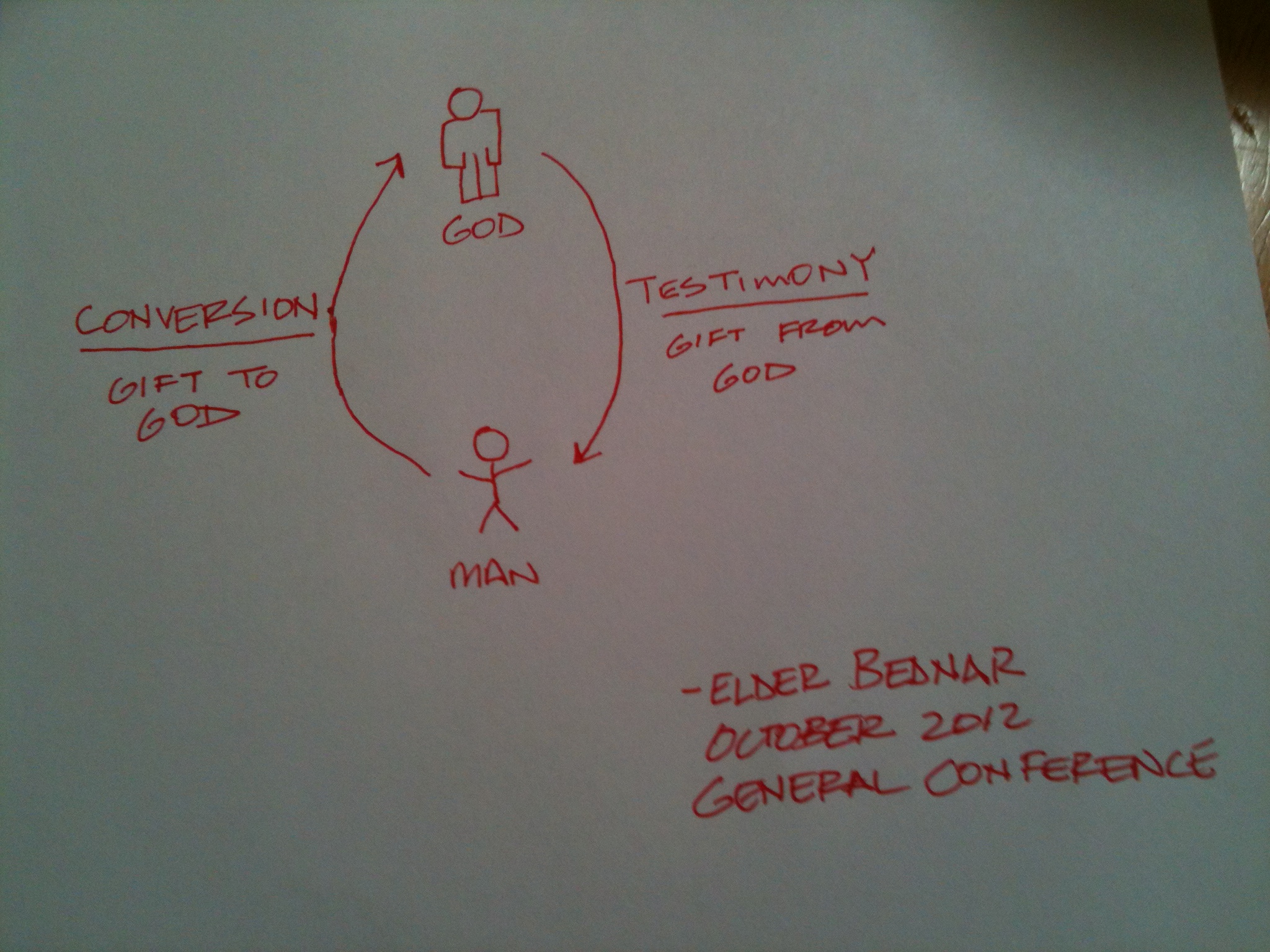
Elder David A. Bendar taught on the relationship between testimony and conversion:

On Testimony
“A testimony is a gift from God and is available to all of His children. Any honest seeker of truth can obtain a testimony by exercising the necessary “particle of faith” in Jesus Christ to “experiment upon” (Alma 32:27) and “try the virtue of the word” (Alma 31:5), to yield “to the enticings of the Holy Spirit” (Mosiah 3:19), and to awaken unto God (see Alma 5:7). Testimony brings increased personal accountability and is a source of purpose, assurance, and joy.”

On Conversion
“Conversion is an enlarging, a deepening, and a broadening of the undergirding base of testimony. It is the result of revelation from God, accompanied by individual repentance, obedience, and diligence. Any honest seeker of truth can become converted by experiencing the mighty change of heart and being spiritually born of God (see Alma 5:12–14). As we honor the ordinances and covenants of salvation and exaltation (see D&C 20:25), “press forward with a steadfastness in Christ” (2 Nephi 31:20), and endure in faith to the end (see D&C 14:7), we become new creatures in Christ (see 2 Corinthians 5:17). Conversion is an offering of self, of love, and of loyalty we give to God in gratitude for the gift of testimony.”

Converted Unto the Lord

October 2012 General Conference

As I consider this, a simple graphic emerged:

Find Joy in the Journey

President Dieter F. Uchtdorf taught,

“Sometimes in life we become so focused on the finish line that we fail to find joy in the journey. I don’t go cycling with my wife because I’m excited about finishing. I go because the experience of being with her is sweet and enjoyable.

“Doesn’t it seem foolish to spoil sweet and joyful experiences because we are constantly anticipating the moment when they will end?

“Do we listen to beautiful music waiting for the final note to fade before we allow ourselves to truly enjoy it? No. We listen and connect to the variations of melody, rhythm, and harmony throughout the composition.

“Do we say our prayers with only the “amen” or the end in mind? Of course not. We pray to be close to our Heavenly Father, to receive His Spirit and feel His love.

“We shouldn’t wait to be happy until we reach some future point, only to discover that happiness was already available—all the time! Life is not meant to be appreciated only in retrospect. ‘This is the day which the Lord hath made … ,’ the Psalmist wrote. ‘Rejoice and be glad in it.'”

“Of Regrets and Resolutions”
October 2012 General Conference

Busyness as a Badge of Honor

President Dieter F. Uchtdorf warned us of the regrets we may have if we fill our lives with things that are eternally unimportant. He taught,

“Isn’t it true that we often get so busy? And, sad to say, we even wear our busyness as a badge of honor, as though being busy, by itself, was an accomplishment or sign of a superior life.

“Is it?

“I think of our Lord and Exemplar, Jesus Christ, and His short life among the people of Galilee and Jerusalem. I have tried to imagine Him bustling between meetings or multitasking to get a list of urgent things accomplished.

“I can’t see it.

“Instead I see the compassionate and caring Son of God purposefully living each day. When He interacted with those around Him, they felt important and loved. He knew the infinite value of the people He met. He blessed them, ministered to them. He lifted them up, healed them. He gave them the precious gift of His time.”

Of Regrets and Resolutions
October 2012 General Conference

Following Promptings in Serving Others

President Thomas S. Monson taught,

“In the performance of our responsibilities, I have learned that when we heed a silent prompting and act upon it without delay, our Heavenly Father will guide our footsteps and bless our lives and the lives of others. I know of no experience more sweet or feeling more precious than to heed a prompting only to discover that the Lord has answered another person’s prayer through you.”

“Peace, Be Still,” Liahona and Ensign, Nov. 2002, 55.

Kindness Begins in the Home

Elder Quentin L. Cook taught us of the importance of the home and family and its impact on society. He said,

The foundation of kindness and civility begins in our homes. It is not surprising that our public discourse has declined in equal measure with the breakdown of the family. The family is the foundation for love and for maintaining spirituality. The family promotes an atmosphere where religious observance can flourish. There is indeed “beauty all around when there’s love at home.”

“Can ye feel so now?”
October 2012 General Conference

Two Key Factors of Lessened Commitment

Quentin L. Cook of the Quorum of the Twelve Apostles made this observation,

While anything that lessens commitment is of consequence, two relevant challenges are both prevalent and significant. The first is unkindness, violence, and domestic abuse. The second is sexual immorality and impure thoughts. These often precede and are at the root of the choice to be less committed.

2012 October General Conference, “Can Ye Feel So Now?”

Fear to Sin

As I was reading this morning, I came across this verse from Samuel the Lamanite’s preaching to the Nephites:

And ye know also that they have buried their weapons of war, and they fear to take them up lest by any means they should sin; yea, ye can see that they fear to sin—for behold they will suffer themselves that they be trodden down and slain by their enemies, and will not lift their swords against them, and this because of their faith in Christ. (Book of Mormon, Helaman, Chapter 15:9)

The phrase that really stood out was that they fear to sin. As a matter of self-reflection, how often do I fear to sin? Sometimes my own attitude is, “Oops, well I didn’t mean to.” What can be done to develop a fear to sin?

Importance
There might be some who say that to fear to sin is a little overkill. Do your best and if you slip up, oh well–you tried. I don’t know if they have a full understanding of the gravity of sin.

The Lord has said,

For I the Lord cannot look upon sin with the least degree of allowance; (Doctrine and Covenants, Doctrine and Covenants, Section 1:31)

Besides being perfect and glorified, our Savior is personally invested in our righteousness:

Therefore I command you to repent—repent, lest I smite you by the rod of my mouth, and by my wrath, and by my anger, and your sufferings be sore—how sore you know not, how exquisite you know not, yea, how hard to bear you know not.

For behold, I, God, have suffered these things for all, that they might not suffer if they would repent; (Doctrine and Covenants, Doctrine and Covenants, Section 19:15-16)

But sometimes our attitude resembles what Jacob, the brother of Nephi described as an unrighteous assumption:

And there shall also be many which shall say: Eat, drink, and be merry; nevertheless, fear God—he will justify in committing a little sin; yea, lie a little, take the advantage of one because of his words, dig a pit for thy neighbor; there is no harm in this; and do all these things, for tomorrow we die; and if it so be that we are guilty, God will beat us with a few stripes, and at last we shall be saved in the kingdom of God. . . . and their works shall be in the dark. (Book of Mormon, 2 Nephi, Chapter 28:8-9)

I can’t imagine anyone who has at least a small understanding of what the Savior went through on our behalf would be willing to cause additional suffering for the Savior.

Learning to Fear to Sin
In considering how one can develop this Christian trait, a few scriptural examples come to mind.

Pondering and Meditation
When the angel comes to help Alma the Younger consider his ways, the angel demonstrates the power of God and then invites him to remember the captivity of His fathers.

Moroni, at the close of the Book of Mormon invites us to ponder on how good God had been since the fall of Adam until the present time (see Moroni 10:3).

There’s value in taking time and pondering on both in the scriptures and in our own life, how The Lord has continually poured out blessings and mercy upon us. When we internalize that grace and how merciful He is, we understand how indebted we are and seek to reflect our gratitude in righteous living.

Seeing Sin for What it is
As the people of King Benjamin felt the import of his teaching, they fell to the earth because they viewed themselves in their carnal state. They cried out for Christ to apply His redeeming blood on their behalf.

We can pray to understand better the gravity of sin. Like for King Benjamin’s people, that will come readily as we learn the word of God and seek to live it.

Avoid Making Excuses
After teaching his wayward son, Corianton about the atonement, justice and mercy, he leaves his son with this counsel:

Do not endeavor to excuse yourself in the least point because of your sins, by denying the justice of God; but do you let the justice of God, and his mercy, and his long-suffering have full sway in your heart; and let it bring you down to the dust in humility. (Book of Mormon, Alma, Chapter 42:30)

Excuses weaken our sense of agency and accountability because we tell ourlselves and others that our actions to some other power or circumstance other than our own will.

As Alma describes, this leads us to deny the justice of God. By holding the justice of God at bay, we lose the fear to sin.

With a greater sense of personal responsibility that is devoid of excuses, we can let the justice of God have sway in our heart. Small sins that were written off before begin to matter, and with a heightened sense of conscience, we can more fully put off the natural man, and become a saint (see Mosiah 3:19)