

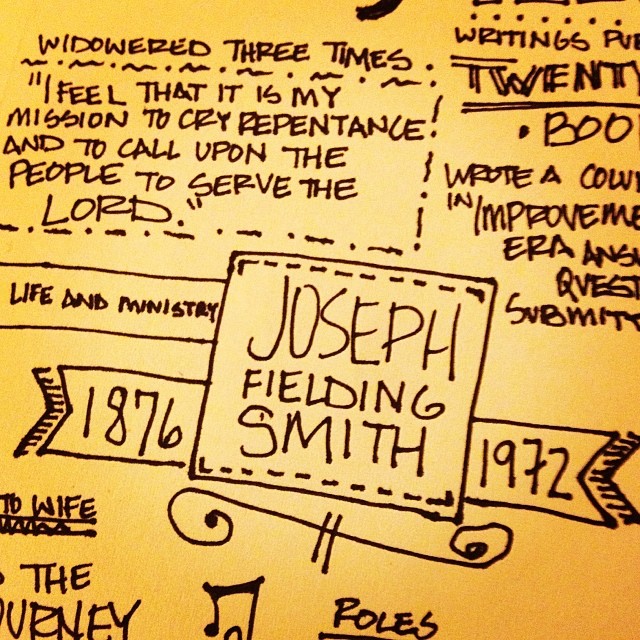
Joseph Fielding Smith served as a member of the Quorum of the Twelve Apostles for 60 years before becoming the 10th president of the Church of Jesus Christ of Latter-day Saints.




As a kid, I remember coming into my dad’s office at work to see his desktop calendar doodled up while he occupied his hand on long phone calls. He’d let me tack on doodles of my own. I liked to draw, but never took any specific classes beyond the weekly art class in elementary school. I took one semester of art in middle school which gave me a little more confidence and practice, but that was it.
I’ve always been a journal writer, which gave me plenty of margins and white space to fill with doodles. That fed my interest in taking notes at Church meetings, especially general conference.
Fast forward to my mission. It was the first time other people really took a close look at my notes as I’d have a pocket full of colored pens, and I’d change up the colors as I took notes in MTC devotionals and later zone conferences. I also loved to fill the chalkboard in our classroom with notes and diagrams during personal study.
One of my MTC companions took notice, and was kind enough to purchase a black sketchbook for my mission. I still refer and add to that note book for different visual representations of the gospel as I come across them.
It wasn’t until my first job out of college that I realized that I wasn’t alone, that there wasn’t just others out there doing this kind of thing, but that it had a name and following. Ben Norris gave a presentation at a conference I attended on sketchnotes. It rekindled the fire for me, and now after a few years, has resulted in this website and blog.
Now I sketchnote a number of things on a regular basis:
I share my story for a few reasons:
One, you might be a sketchnoter and you might not even realize it.
Two, I have zero formal training, just lots of practice in a variety of settings. So don’t feel like this is something completely out of reach.


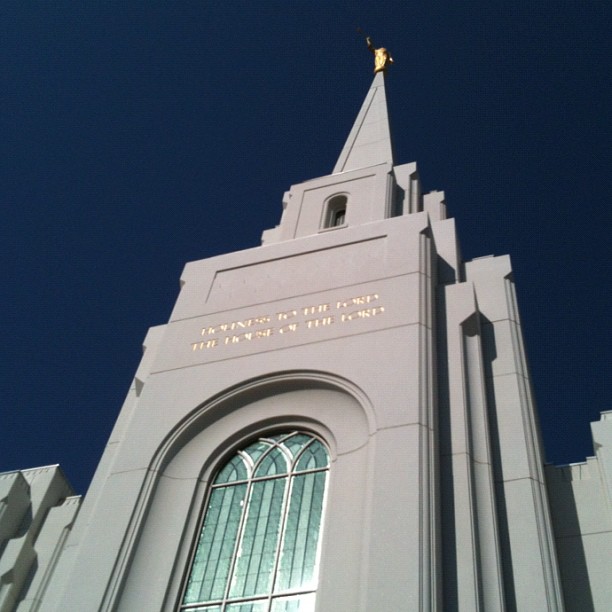
In the Book of Mormon, two prophets (first Lehi, then his son, Nephi) see a vision about the path that leads to experiencing a fullness of God’s love, represented by partaking of the fruit of the tree of life.
Partaking of the fruit required an individual to enter the path, take hold of the iron rod, advance through the midst of darkness by holding to the rod to the end of the path. There were many who failed to hold to the rod or otherwise got lost in their efforts. Because life can be so unpredictable in what challenges arise, I think the iron rod underlines the significance and power of making and keeping commitments and covenants.
Elder J. Golden Kimball said, paraphrasing, “I may not always walk the straight and narrow but I sure try to cross it as many times as I can.” We all make mistakes as part of the learning process. While the blessings of the atonement are contingent upon our faithfulness to God’s commandments, the Lord’s work and glory is our progression to eternal life. To the degree we are willing to learn and change, He has every motivation to help us.
King Benjamin reminds us that, “he never doth vary from that which he hath said; therefore, if ye do keep his commandments he doth bless you and prosper you.” As we commit to change, our repentance enables us to make meaningful and lasting development that get us back on the path that qualifies us for greater blessings.
As our faith and commitment to change deepens, we are both worthy and willing to solidify our resolve by way of covenant with God. These covenants strengthen our place on the path moving forward in a number of ways but I’ll mention two:
The Lord rewards our covenant-making with special blessings that further enable us to keep the covenants we make. Baptism is followed by the gift of the Holy Ghost, which both guides and sanctifies us. Further, we refer to our temple covenants as an endowment. As the Lord instructed Joseph,
“Verily I say unto you, it is expedient in me that the first elders of my church should receive their endowment from on high in my house, which I have commanded to be built unto my name in the land of Kirtland ….
“And inasmuch as they follow the counsel which they receive, they shall have power after many days to accomplish all things pertaining to Zion.”
Elsewhere in the scriptures the phrase is used that we are endowed with power. Which brings me to the second reason why our covenants are so important to the purpose of our existence. Our covenants are a source of power because they put us in a contractual agreement with the Savior Himself. It is His power we are able to draw on. As we take upon us the name of Christ and become joint-heirs with Him (Romans 8:17), “his divine power hath given unto us all things that pertain unto life and godliness” (2 Peter 1:3). Ultimately it is that relationship that allows us to inherit all that the Father hath (D&C 84:33-39).
How important are our covenants? Returning to the imagery we began with, the Lord told Joseph Smith,
“Verily I say unto you, all among them who … are willing to observe their covenants by sacrifice—yea, every sacrifice which I, the Lord, shall command—they are accepted of me.
“For I, the Lord, will cause them to bring forth as a very fruitful tree which is planted in a goodly land, by a pure stream, that yieldeth much precious fruit” (D&C 97:8–9).

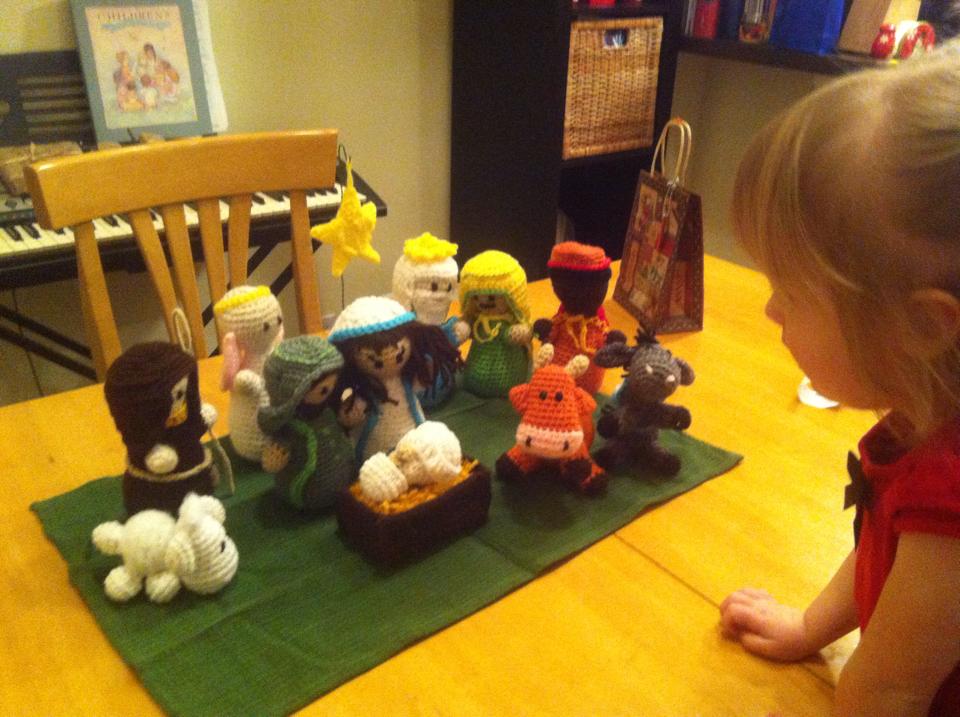
Today as my daughter was opening the last of the nativity set, she got baby Jesus to add to the other figures.
As I thought about it, I was reminded from this year’s Christmas devotional where Elder Rasband made the statement about the role of the shepherd as witnesses and as such they were worthy and just.
It occurred to me that there are parallels between those witnesses and the witnesses who testified of the origins (nativity, if you will) of the restoration, represented by the Book of Mormon.
The Book of Mormon had three original witnesses, furthered by 8 additional witnesses. Eleven total to stand with Joseph affirming that they saw the plates from which the Book of Mormon came from.
Christ’s birth was witnessed by three wise men, a number of shepherds, and the old man at the Temple. We don’t know the exact count this comes to and undoubtedly there were others, but there is a simple symmetry there.
In both cases it would be a few years before special witnesses, apostles, would be called–but our Heavenly Father called just men to testify of His divine work, to establish the seeds of faith in an otherwise time of confusion and difficulty, which led to the more formal organization of His work in each given time.
It affirmed for me both of the restoration and the divinity of the Savior. Both have such significant roles respectively in helping us understand the who and why we worship, that God prepared a way by which people could exercise faith in the origins of that dispensation.






In my study of the Book or Mormon, I came across a verse that had special meaning to me as a missionary.
As my last transfer drew to a close, It was naturally to look back and ask, ‘is there more I could have done? How did I do? Was I a good missionary?’
No immediate peace came with such contemplation. I knew my weaknesses and I was afraid that some of them were rather glaring. For example, it bothered me that I never got used to contacting. Everyday was like the first day. It never came naturally. I also had an excellent memory and could easily recall moments I wasn’t proud of.
These weighed on me. I kept working, I kept giving it my best effort, but in the back of my mind these things festered.
It was at some point near the end of my last transfer I read about Alma and the struggles and setbacks he experienced watching the Church under his watch studded a little bit:
And now it came to pass that Alma, having seen the afflictions of the humble followers of God, and the persecutions which were heaped upon them by the remainder of his people, and seeing all their inequality, began to be very sorrowful;nevertheless the Spirit of the Lord did not fail him. (Alma 4:15, emphasis added).
As I was invited at my last zone conference to speak, this verse came to mind while I was on my feet. I quickly realized that this was true for me. Yes, I struggled. Yes, there were challenges. Yes, I made some stupid mistakes. But I never gave up, I kept moving in the right direction. And most importantly, the Spirit did not fail me. I never felt alone, and recognized throughout my mission the Spirit teaching me and teaching others through me.
And if I had the spirit, that means I was worthy. Which was a witness to me that The Lord accepted my efforts.
Sometimes that is still hard for me to remember and focus on. I get impatient with myself, I feel like I should be further along in some categories. Other things don’t come as naturally as I hoped they would and I am painfully aware of where I come up short.
But let all that go for a moment and just focus on having the Spirit. That is the reminder of every sacrament meeting: that The Lord will grant His Spirit to the willing. If we will keep at it, His spirit will sustain our efforts
and help us yield fruit. And then at some future day we’ll peak back over our shoulder and realize just how far we’ve come.


You must be logged in to post a comment.