The Constitution: The Battle for Everything

As the unfortunate events of a few weeks ago have led to the current debate over the second amendment and so forth, there’s a lot of merit on both sides of the argument. This isn’t the first time that something so seemingly fundamental as the constitution has been debated, and it certainly won’t be the last.

My purpose isn’t to debate or lobby for one side or the other on a given issue, except to make an observation on why it seems like these kind of debates in recent years have gotten more bitter, more divided and much harder to find middle ground.

Why the Constitution Has Worked for 200+ Years

I firmly believe in the words revealed to the prophet Joseph Smith that, “[The Lord] have suffered [the laws and constitution of the people] to be established, and should be maintained for the rights and protection of all flesh, according to just and holy principles;”

“And for this purpose have I established the Constitution of this land, by the hands of wise men whom I raised up unto this very purpose, and redeemed the land by the shedding of blood,” (D&C 124: 77,80).

Speaking of those wise men, consider the words of John Adams on the subject,

 “We have no government armed with power capable of contending with human passions unbridled by morality and religion . . . Our Constitution was made only for a moral and religious people. It is wholly inadequate to the government of any other,” (Speech to the Military, 1798).

Behind why we struggle to find common ground

Of course, over the past two hundred plus years, it has not been all roses. There have been many issues that come down to how we view and interpret the constitution.  So here we are entering 2013 and consider all the different debates that continue to be hot topics:

  • Death Penalty
  • Abortion
  • Definition of Marriage
  • Gun Control
  • Privacy
  • Debt Crisis
  • Role of Religion in Society

In saying what I am about to say, I hope to say it tentatively without trying to say which side is right or wrong. But it would seem that many of these issues would not be as much of an issue if morality and religion had a more significant place in the hearts of individuals.

Consider the current gun control debate and why we struggle to agree on interpreting the second amendment. Part of the challenge is that there is an increasing trend of individuals who struggle to adhere to a fundamental societal moral conveyed in the Judeo-Christian commandment, Thou Shalt Not Kill.  As incivility manifests itself in escalating proportions, as a society we disagree on the course of action to take to try to right those offenses.

So where do morals, respect, compassion and civility come from? Where are they learned? What I truly hope to advocate is the ever-increasing importance of the home and the impact it can have on a society that is struggling to find its way forward.

I am absolutely positive that if we strengthen and support the home and family, many of the issues that beget so many of the political and policy driven debates we have today would diminish.

Is that too idealistic? Is that to simple? The best day to plant an apple tree was 25 years ago, the second best day is today. Doing more today to strengthen our respective homes and families may not yield the societal peace we strive for immediately, but it will begin the process of investing in a future that is more secure and bright. More importantly we can give a secure and stable footing for our children.

Let’s consider what we can do to plant the seeds in our respective home and family environments today.
What is conversion?

Elder David A. Bednar of the Quorum of the Twelve Apostles taught,

“Conversion is an enlarging, a deepening, and a broadening of the undergirding base of testimony. It is the result of revelation from God, accompanied by individual repentance, obedience, and diligence. Any honest seeker of truth can become converted by experiencing the mighty change of heart and being spiritually born of God (see Alma 5:12–14). As we honor the ordinances and covenants of salvation and exaltation (see D&C 20:25), “press forward with a steadfastness in Christ” (2 Nephi 31:20), and endure in faith to the end (see D&C 14:7), we become new creatures in Christ (see 2 Corinthians 5:17). Conversion is an offering of self, of love, and of loyalty we give to God in gratitude for the gift of testimony.”

David A. Bednar
“Converted unto the Lord”
2012 October General Conference

The Sacrament and Forgiveness

President Boyd K. Packer said:

“The sacrament renews the process of forgiveness. Every Sunday when the sacrament is served, that is a ceremony to renew the process of forgiveness. … Every Sunday you cleanse yourself so that, in due time, when you die your spirit will be clean.”

Mine Errand from The Lord (2008), 196.

Knowing God

In preparation for the talks we will be giving in Church next week, Elizabeth and I had a discussion last night over dinner. She asked me about Elder Hallstrom’s remarks in April 2012 General Conference. On strengthening the role of the Gospel and the Church in our personal discipleship, Elder Hallstrom stated,

“A sustained knowledge of and love for the three members of the Godhead are indispensable. Mindfully pray to the Father, in the name of the Son, and seek direction from the Holy Ghost,” (emphasis added; “Converted to His Gospel through His Church”, Donald L. Hallstrom).

Elizabeth and I discussed the use of the word indispensable. As Elizabeth and I discussed, we realized a couple of things.

First, we considered how hard it is to have a relationship when one person in that relationship has a completely erred concept of the other person’s identity and key attributes. Imagine a first date scenario where the boy mistakenly thinks that his date is seven months pregnant and continues to operate on that assumption even though she’s not. What hope is there for this potential relationship to go anywhere unless he corrects his perception? When we fundamentally get wrong key aspects of our relationship with God the Father and Jesus Christ, we’re limited in our ability to interact and connect with them until that perception is corrected.  For example we might,

  • Misunderstand God’s intent and purpose, leading us to question him: ‘Why would God let this happen?’
  • Mistake the consequences of sin as God passing judgement on us and we assume we’re a hopeless case.
  • Fail to understand that God’s grace and mercy does not mean that we can sin now and repent later.

Without truly understanding who God is and what His key attributes are, there are many ways we might be deceived. Further, if we fundamentally misunderstand who he really is, how do we know how to please him? How can we properly understand what is important to him?

Second, and closely associated with above, to fail to understand God and Jesus Christ, we fail to understand ourselves and our potential as God’s sons and daughters. Elder Dallin H. Oaks taught,

the Final Judgment is not just an evaluation of a sum total of good and evil acts—what we have done. It is an acknowledgment of the final effect of our acts and thoughts—what we have become. It is not enough for anyone just to go through the motions. The commandments, ordinances, and covenants of the gospel are not a list of deposits required to be made in some heavenly account. The gospel of Jesus Christ is a plan that shows us how to become what our Heavenly Father desires us to become,” (“The Challenge to Become”, October 2000 General Conference).

Without fully understanding our divine potential and God’s purposes in giving us commandments, ordinances and covenants, it’s possible to do and say those things that seem to be right in the sight of God by still have our hearts far from him.


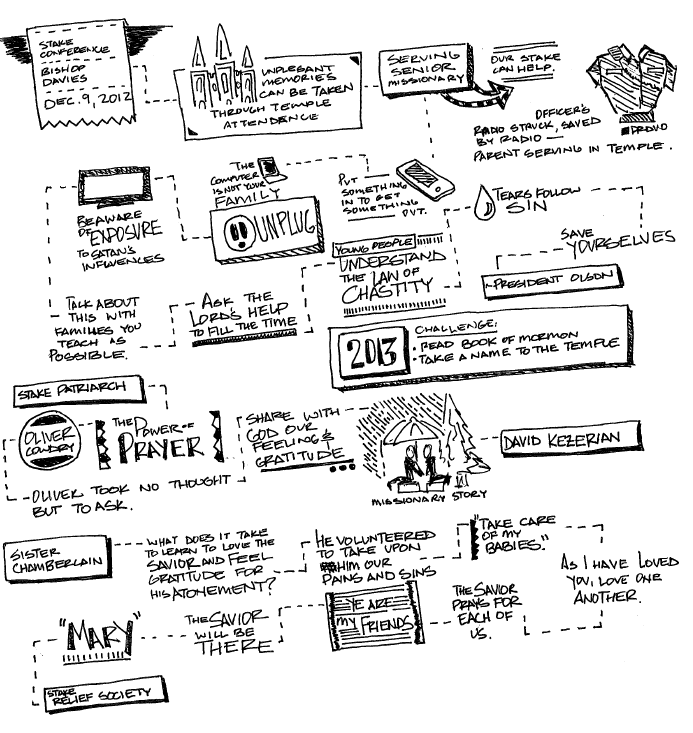
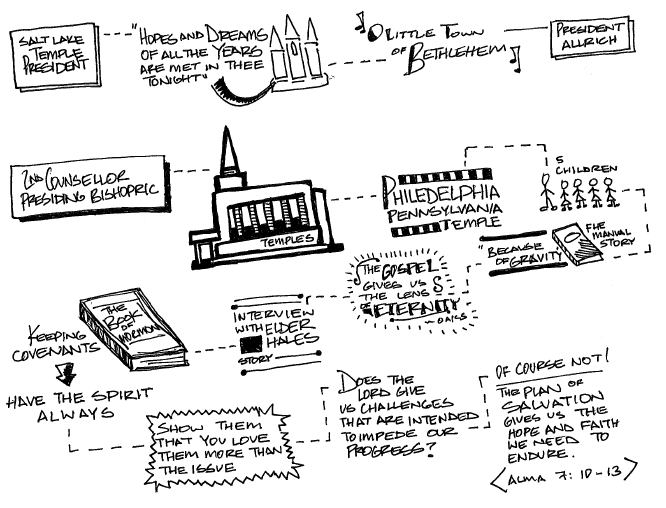
Sketchnotes – Stake Conference with Bishop Davies of the Presiding Bishopric

We had stake conference this month with Bishop Dean M. Davies of the Presiding Bishopric as well as the President of the Salt Lake Temple. Before the meeting we had the chance to meet Bishop Davies and exchange quick pleasantries. Before being called in this most recent conference to the Presiding Bishopric, Bishop Davies served in the Temple Department, helping select sites for temples. He drew on that experience as he spoke to us, sharing insights into revelation as well as the miracles that will accompany our efforts as we strive to do the work of the Lord.

Stake Conference, page 1
Stake Conference, page 2