As Man Now Is . . .

From Preston Nibley’s Presidents of the Church, we read,

While visiting at the home of Elder H.G. Sherwood, Lorenzo relates that the conversation turned to religious matters. “Elder Sherwood was endavoring to explain the parable of the Savior when speaking of the husbandman who hired servants and sent them forth at different hours of the day to labor in his vineyard.” While Lorenzo listened closely to the explanation, “the Spirit of the Lord rested mightily upon me –the eyes of my understanding were opened, and I saw as clear as the sun at noon-day, with wonder and astonishment, the pathway of God and man. I formed the following couplet which expresses the revelation as it was shown to me: ‘As man is, God once was, As God now is, man may become.’ “

Later in the Improvement Era, Lorenzo Snow published the full poem:

Hast thou not been unwisely bold,
Man’s destiny to thus unfold?
To raise, promote such high desire,
Such vast ambition thus inspire?

Still ’tis no phantom that we trace
Man’s ultimatum in life’s race;
This royal path has long been trod
By righteous men, each now a God:

As Abra’m, Isaac, Jacob, too,
First babes, then men—to gods they grew.
As man now is, our God once was;
As now God is, so man may be,—
Which doth unfold man’s destiny.

. . . . . . . . . . . . . . . .

The boy, like to his father grown,
Has but attained unto his own;
To grow to sire from state of son,
Is not ’gainst Nature’s course to run.

A son of God, like God to be,
Would not be robbing Deity;
And he who has this hope within,
Will purify himself from sin.

(Lorenzo Snow, “Man’s Destiny,” Improvement Era, June 1919, pp. 660–61.)

Meet Lorenzo Snow

In preparation for the new year, where we will be learning from the life and teachings of   President Lorenzo Snow in Priesthood and Relief Society. I wanted to gather some facts and aspects from his life.

  • President Snow was born April 3, 1814 and grew up in Mantua, Ohio. He was attending Oberlin College when he met David W. Patten, a missionary for the the Church and one of the original members of the Quorum of the Twelve Apostles.
  • His sister, Eliza R. Snow had joined the Church and invited him to visit Kirtland. He accepted. He came to know Joseph Smith and received a testimony of the work. He was baptized in June 1836.
  • After serving a couple of missions in Ohio, Southern Illinois and Kentucky, he returned to Nauvoo. In a discussion with Elder H.G. Sherwood who was teaching on the parable of the Savior regarding the Laborers in the Vineyard, Lorenzo received the following couplet in revelation: “As man now is, God once was, / As God now is, man may become.”
  • Lorenzo was called on a mission to England, where he served with Brigham Young, Heber C. Kimball and Parley P. Pratt. After returning he was called on a mission to Ohio where he was when he heard the news of the Prophet’s martyrdom.
  • Lorenzo arrived in the Salt Lake Valley in 1848. In February of the next year, he was invited to meet with the Quorum of the Twelve and was informed he was to become an Apostle. In that October he was sent to proclaim the Gospel in Italy.
  • Upon returning home he was called to settle Box Elder area, they called the settlement Brigham City. He spent 20 years developing a robust economy there with over $40,000 of goods produced annually.
  • In 1872-73, Lorenzo Snow with other church leaders toured Europe and visited the Holy Land.
  • Elder Snow was imprisoned for 11 months for ‘unlawful cohabitation’ under anti-polygamy laws
  • He was sustained the President of the Quorum of the Twelve in 1889. After the dedication of the Salt Lake Temple to oversee the ordinance work of the temple.
  • He was sustained as President of the Church when he was 84 years old.
  • As President of the Church he travelled to St. George where he received the revelation regarding the need for the saints to recommit to the law of tithing.
  • President Snow passed away shortly after the the October conference in 1901. He was 88 years old.

Receive Both Halves of the Blessing

Temple and family history work are two sides to the same important work. President Howard W. Hunter said,

“We must accomplish the priesthood temple ordinance work necessary for our own exaltation; then we must do the necessary work for those who did not have the opportunity to accept the gospel in life. Doing work for others is accomplished in two steps: first, by family history research to ascertain our progenitors; and second, by performing the temple ordinances to give them the same opportunities afforded to the living.

“Yet there are many members of the Church who have only limited access to the temples. They do the best they can. They pursue family history research and have the temple ordinance work done by others. Conversely, there are some members who engage in temple work but fail to do family history research on their own family lines. Although they perform a divine service in assisting others, they lose a blessing by not seeking their own kindred dead as divinely directed by latter-day prophets. …

“I have learned that those who engage in family history research and then perform the temple ordinance work for those whose names they have found will know the additional joy of receiving both halves of the blessing.”

“A Temple-Motivated People,” Liahona, May 1995, 5–6; Ensign, Feb. 1995, 4–5.

Effective crisis communication material? – From Instagram [Pic]

This weekend we took part in the Free public day for the UTA Frontrunner opening from Salt Lake to Provo. We were fortunate to find a seat on the train right by a door connecting our car with the next car. Being a communication major I couldn’t help but notice the signage.

Granted, there’s only so much you can do to make an emergency release for a heavy metal door and still preserve the integrity of the door, but these instructions made me smile.
Effective crisis communication material? via Instagram

God is Never Hidden

Speaking of Joseph Smith’s experience in Liberty Jail, Henry B. Eyring observed,

“In the depths of his anguish in Liberty Jail, the Prophet Joseph Smith cried out: “O God, where art thou? And where is the pavilion that covereth thy hiding place?” Many of us, in moments of personal anguish, feel that God is far from us. The pavilion that seems to intercept divine aid does not cover God but occasionally covers us. God is never hidden, yet sometimes we are, covered by a pavilion of motivations that draw us away from God and make Him seem distant and inaccessible. Our own desires, rather than a feeling of “Thy will be done,” create the feeling of a pavilion blocking God. God is not unable to see us or communicate with us, but we may be unwilling to listen or submit to His will and His time.”

“Where Is the Pavilion?”
2012 October General Conference,

What the Nephites taught me about the Sacrament

In our reading of the Book of Mormon, we have reached the the crowning event: the Savior’s visit to the people after his resurrection and ascension as recorded in the New Testament.

You’ll recall that many are gathered in the land of bountiful, discussing the various signs and destructions that occurred at the time of the Savior’s death. They hear a voice and see a man clothed in white descending from on high.

He speaks, “I am Jesus Christ.” The people feel the prints in his feet and hands. He calls disciples to minister to the people. He teaches them his doctrine, the same teachings we read of in the Sermon on the Mount in the New Testament. He teaches them about baptism, and to lay down contention.

After so much teaching, we read,

Behold, now it came to pass that when Jesus had spoken these words he looked round about again on the multitude, and he said unto them: Behold, my time is at hand.

I perceive that ye are weak, that ye cannot understand all my words which I am commanded of the Father to speak unto you at this time.

Therefore, go ye unto your homes, and ponder upon the things which I have said, and ask of the Father, in my name, that ye may understand, and prepare your minds for the morrow, and I come unto you again, (3 Nephi 17:1-3).”

They have just spent many hours with the Son of God and he mercifully recognizes they need some time to digest all that he has taught them. And yet,

And it came to pass that when Jesus had thus spoken, he cast his eyes round about again on the multitude, and beheld they were in tears, and did look steadfastly upon him as if they would ask him to tarry a little longer with them.

And he said unto them: Behold, my bowels are filled with compassion towards you, (3 Nephi 17:5-6).”

They could not even necessarily understand Him, but they just wanted Him to stay with them a little longer. Chapter 17 continues with a beautiful account of Christ healing all their sick, and inviting the children to come unto him. Angels descend and they are surrounded as by fire. Christ prays with them and for them. “No tongue can speak, neither can there be written by any man, neither can the hearts of men conceive so great and marvelous things as [they] both saw and heard Jesus speak, (3 Nephi 17:17).”

Even more interesting is what happens next. Christ instructs His disciples to go get bread and wine. He institutes the sacrament with the Nephites and shares with them a few additional thoughts and then ascends into heaven.

The Sacrament

As we read this in our family reading, it occurred to me that the Sacrament occurred after the Savior realized the people were weak and could hardly understand. As I reflected on that, I think it illustrates an important principle of the sacrament.

Compare these words of the sacrament prayer with the desires of the Nephites:

…that they may eat in remembrance of the body of thy Son, and witness unto thee, O God, the Eternal Father, that they are willing to take upon them the name of thy Son, and always remember him, and keep his commandments which he hath given them, that they may always have his Spirit to be with them…” (Moroni 4).

And the desires of the Nephites:

…when Jesus had thus spoken, he cast his eyes round about again on the multitude, and beheld they were in tears, and did look steadfastly upon him as if they would ask him to tarry a little longer with them.”

They could not necessarily understand everything he had to say, but they were willing to understand. They were desirous to have His presence with him.

What I started to understand a little bit better here is how important the role of our desire and our heart is. Sometimes I let myself get bogged down in the mechanics of life. What I know or what I don’t know. But when it comes down to the sacrament, and that weekly opportunity to renew my covenants with the Savior, it all comes down to a simple question, ‘where is my heart?’

Can I imagine myself sitting in the presence of the Savior tapping foot, getting impatient for the meeting to end so I can get back to my life? Or would I be like the Nephites, and desire that He would tarry a little longer with me.

I think that is the beauty of the sacrament: despite everything else that goes on in life, and the struggles we have in our own way of comprehending the full import of trying to live the gospel in our lives, we can step back and ask that His spirit be with us a little longer. And if our hearts are right and we’re willing to repent, week after week that blessing is continually extended.


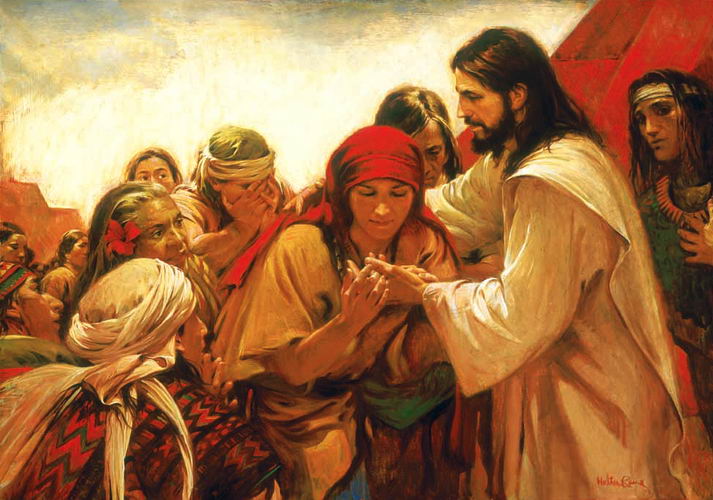
Featured image: “One by One‘ Walter Rane

The Temple: No Sacrifice is Too Great

President Thomas S. Monson said,

Why are so many willing to give so much in order to receive the blessings of the temple? Those who understand the eternal blessings which come from the temple know that no sacrifice is too great, no price too heavy, no struggle too difficult in order to receive those blessings. There are never too many miles to travel, too many obstacles to overcome, or too much discomfort to endure. They understand that the saving ordinances received in the temple that permit us to someday return to our Heavenly Father in an eternal family relationship and to be endowed with blessings and power from on high are worth every sacrifice and every effort.

Thomas S. Monson
The Holy Temple–A Beacon Unto the World
April 2011 General Conference